
Reviewed · GUIDED
Roman Archeology Guided Tour Thuburbo Majus & Uthina
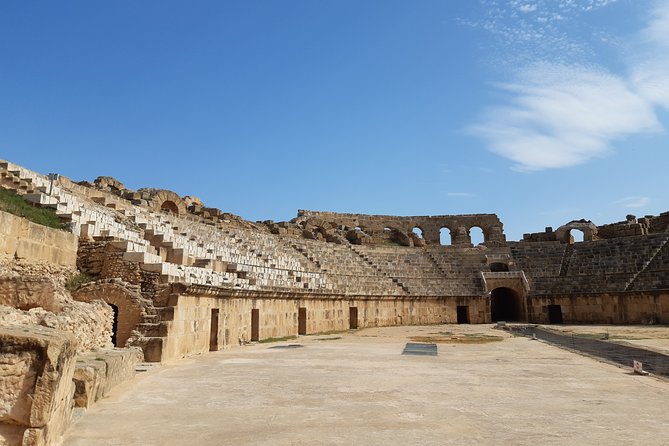
Uthina’s enormous Roman amphitheatre is the star of this outing. It could hold about 20,000 spectators, and the site has only recently been fully excavated. Add Thuburbo Majus, with its tall Capitol columns and Roman baths, and you get a serious archaeology day away from Tunis. I especially like the private format and the chance to travel with a guide such as Fathi, a retired professor who brings real historical depth to the ruins.
I also like the variety. You see an ancient city, a major water system, and a second Roman center rather than spending the entire day at one monument. The main drawback is pace: seven hours covers a lot of ground, and the Zaghouan aqueduct may be viewed only from the road unless you ask to stop. The advertised visit to Zaghouan’s Andalusian medina should also be confirmed when you book.
Key points at a glance
- Uthina’s 20,000-seat amphitheatre: A vast, recently excavated arena with an unusually strong sense of scale.
- A 132-kilometer Roman aqueduct: See part of the system that carried roughly 30 million liters of water each day toward Carthage.
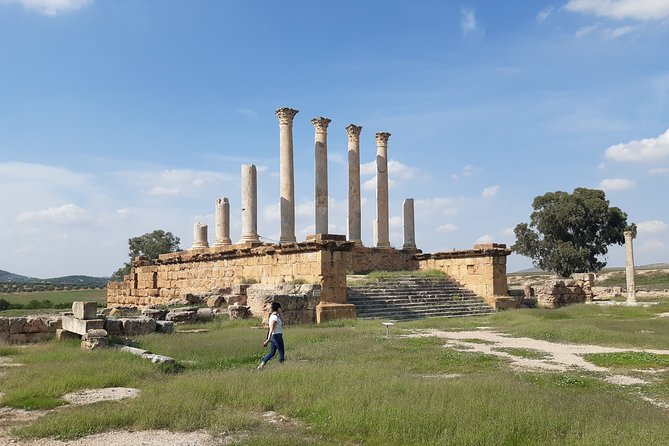
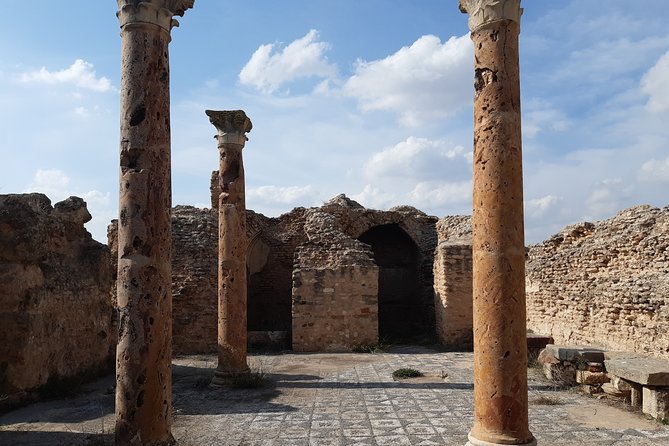
- Thuburbo Majus’s Capitol: Four surviving Corinthian columns rise above the forum staircase.
- A private seven-hour outing: Your group travels alone in an air-conditioned vehicle with WiFi on board.
- A guide who can add real context: Fathi, a retired professor, has led this route with a teaching-focused approach.
- A flexible stop at Zaghouan: The aqueduct stop is brief, so ask in advance if you want time for photos or a closer look.
Why these Roman sites are worth your day
Tunis gives you easy access to some of North Africa’s finest Roman remains, but the best-known sites can dominate a first itinerary. This tour takes you to places that often feel quieter and more open, where the scale of Roman building is easier to grasp.
I like the way the route connects three practical parts of Roman life. Uthina shows political and public spectacle. The Zaghouan aqueduct shows how Rome moved water across difficult ground. Thuburbo Majus brings you into the civic center of a prosperous provincial city, with temples, baths, and a forum.
The sites are not polished theme-park attractions. You are visiting extensive archaeological remains, and the pleasure comes from reading the ruins with help. A good guide can explain why a foundation matters, how a temple related to the forum, and why an amphitheatre was such a major investment.
That makes the quality of the guide important. Fathi is described as a retired professor with a passion for teaching. For this particular tour, that background matters more than a quick list of dates. You will get the most from the day if you enjoy asking questions and looking closely at construction details rather than simply collecting photographs.
A few more Tunis trips to weigh up
- Guided Bike Tour of Carthage Archeological Site in Tunisia
★ 5.0 · 88 reviews - Guided tour in the UNESCO world heritage Medina of Tunis
★ 5.0 · 68 reviews - Group Guided Bike Tour of Carthage Archeological Site in Tunisia
★ 5.0 · 57 reviews
Uthina and its vast Roman amphitheatre
Uthina, also called Oudhna, lies about 30 kilometers south of Tunis. Its position on high ground helped it control routes leading toward Carthage from the south and west. The settlement appears to have older Berber roots, then passed through Punic and Roman phases before later Vandal and Byzantine rule.
The site covers more than 100 hectares, so even the stated one-hour-thirty-minute visit gives you only an introduction. That is both the attraction and the limitation. You get a sense of a large city, but you should not expect to inspect every building in detail.
The amphitheatre deserves priority. It could accommodate around 20,000 spectators, a figure that changes your understanding of Uthina from a small provincial settlement to a place with major public ambitions. Its recent excavation adds to the sense that you are seeing a site still being brought into focus.
I would ask your guide to build the visit around the amphitheatre first. If time remains, use it for the other visible structures rather than rushing from one partial ruin to another. The private format helps here because your group can spend more time on the parts that interest you.
Uthina’s setting also helps you picture the city’s purpose. From its elevated position, it commanded key routes, and the size of its public buildings suggests that it was tied into the Roman economy and political system. You are not just looking at stones scattered over a field. You are seeing the remains of a city placed to watch and serve movement through the region.
Wear practical shoes and bring water. The supplied information confirms a large open archaeological site, but it does not give detailed surface or shade information. I would plan for walking over uneven ground and spending time outside.
The Zaghouan aqueduct and Rome’s water problem
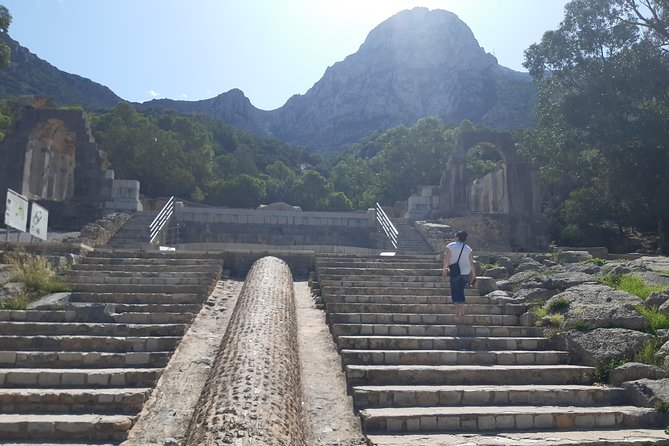
The Zaghouan aqueduct is one of the most useful stops for understanding how Roman cities worked. Built at the beginning of the second century AD, it carried water toward Carthage through a system measuring 132 kilometers.
The engineering challenge was considerable. The channel passed through rugged countryside, running underground in some sections and close to ground level in others. On two stretches, it crossed raised arcades that could reach more than 20 meters high.
Its estimated flow was about 30 million liters per day. Most of that water was stored in large vaulted reservoirs at Maalga, near Carthage, before being sent to the Baths of Antonine. That connection gives the aqueduct real context: it was not an isolated monument, but part of a citywide supply system serving public bathing and urban life.
The scheduled stop is only about 20 minutes, and admission is free. That is enough for a quick explanation and photographs, but it may feel short if you want to study the masonry or walk around. One practical point matters here: the aqueduct may be passed by car rather than visited at length. A previous booking included only a drive past it, with the option to stop if requested.
So ask before departure. If the aqueduct is a main reason you are booking, say clearly that you want a photo stop. The private arrangement makes that request more realistic than it would be on a rigid group coach.
The aqueduct is also a good place to listen rather than rush. Its importance lies less in a single dramatic ruin than in the sheer distance and daily volume of water involved. When you connect it to Carthage’s baths and reservoirs, the Roman system becomes easier to understand.
Thuburbo Majus, the quieter grand finale
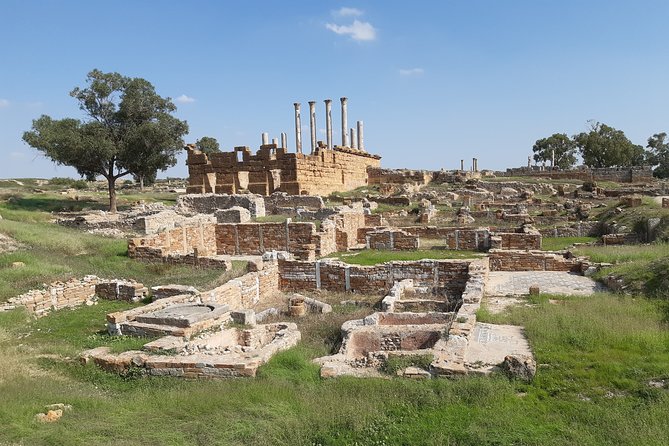
Thuburbo Majus is the tour’s other major archaeological stop. The ancient city grew beside a fertile valley and existed before this part of North Africa became Roman. The remains you see today, however, are mainly from its Roman period.
The city declined during the middle of the third century, then experienced a strong revival in the fourth century. During that later period, it adopted the proud title Respublica Felix Thuburbo Majus, meaning the fortunate republic of Thuburbo Majus.
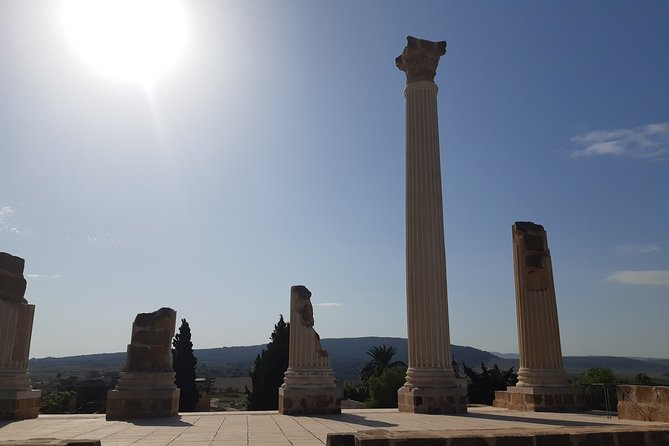
The Capitol is the visual center. In a Roman city, the Capitol was the most important temple, and this one is among the best preserved in Tunisia. Six Corinthian columns once formed its front. Four remain intact, rising above a broad staircase that overlooks the forum.
That view gives you the basic Roman city plan in one glance. The forum was the civic heart, while the Capitol provided the religious and political focus. Even if you are not an archaeology specialist, the surviving columns make the site easy to read.
Thuburbo Majus also had an unusual feature: separate bathing establishments for winter and summer. That detail tells you something about daily life and Roman building habits. Public baths were not simply places to wash. They were major social spaces, and maintaining two facilities required money, workers, and a steady water supply.
The planned visit lasts about one hour. As with Uthina, that is enough to see the main features but not enough for a slow study of every ruin. I would use the hour to focus on the Capitol, forum, and baths, then let your guide fill in the gaps.
The site appears to have made a strong impression because it is larger than some people expect. That is useful to know when planning your day. You are not stopping at a single temple in isolation. Thuburbo Majus is an extensive ancient city, and the hour will pass quickly.
Same coast, a completely different day out:
- Private Tour to Kairouan, El Jem & Monastir from Tunis_hammamet
★ 5.0 · 301 reviews - Private tour: Medina,Carthage ,Sidi Bou Said, Bardo Museum+lunch
★ 5.0 · 230 reviews - Carthage, Bardo Museum, Sidi Bou Said and Medina Private Day Tour
★ 4.5 · 153 reviews - Private Excursion to Testour, Dougga and Bulla Regia from Tunis.
★ 5.0 · 100 reviews
What the private vehicle changes
This is a private activity, so only your group participates. That is a major advantage on a route with several stops and uncertain timing. You are not trying to keep up with a large party while the guide points out details from a distance.
Private transport also makes the day more adaptable. The tour includes an air-conditioned vehicle and WiFi on board, and pickup is offered. A previous booking included flexibility with start and end times, though you should confirm any desired adjustment before reserving rather than assume it is guaranteed.
The drive between sites is part of the experience, but it also takes time away from the ruins. The listed visits add up to roughly two hours and 50 minutes: one hour 30 minutes at Uthina, 20 minutes at the aqueduct, and one hour at Thuburbo Majus. The remaining time includes transport, pickup, and any additional stop connected with Zaghouan.
That math explains why this is best viewed as a broad archaeology day, not a slow research visit. You will sample several important places and rely on the guide to make the connections.
The Andalusian medina of Zaghouan is included in the general description, but the detailed stop information highlights the aqueduct rather than giving a separate medina duration. If the medina matters to you, ask exactly how much time is planned there. This is a small but important booking question.
Is $140.96 a fair price?
At $140.96 per person, the cost is easier to justify for a small private group than for one person traveling alone. The price includes private transportation, an air-conditioned vehicle, WiFi, and all fees and taxes. Lunch is not included.
You are paying for more than admission. Uthina and Thuburbo Majus are spread-out sites outside Tunis, so private transport saves you the trouble of arranging separate rides and coordinating several locations in one day. A guide who can explain Roman urban planning and water engineering adds value that a self-guided visit may not provide.
The value depends on your group size and interests. A couple who wants a full day focused on Roman Tunisia may find the price reasonable, especially if the guide adjusts the pace and answers detailed questions. A solo visitor comparing this with a shared excursion should look closely at the group discount terms before booking.
I would also factor in lunch. Since it is excluded, you need to plan for that expense and clarify whether the day includes a meal stop or simply free time to eat. The supplied details do not specify the restaurant arrangements.
The tour is booked an average of 36 days ahead, which suggests that planning early is sensible, especially if you need a particular date or guide. Confirmation is provided at booking, and cancellation is free if you cancel at least 24 hours before the start time. Inside that window, the payment is not refunded, and changes are not accepted.
Who will enjoy this route most?
I would recommend this outing to you if Roman North Africa is a main reason for visiting Tunis. It gives you three different ways to understand the period: public entertainment at Uthina, infrastructure at the aqueduct, and civic and religious life at Thuburbo Majus.
It also suits you if you prefer a private guide to a large group. The sites are broad, and having your own vehicle and guide makes it easier to ask for clarification or request a short stop.
This may be less suitable if you want a relaxed sightseeing day with long breaks. The route covers a lot of ground, and each archaeological visit has a fixed approximate duration. It is also not ideal if your priority is a long, close study of the Zaghouan aqueduct unless you arrange extra time.
Most travelers can participate, and service animals are allowed. The tour is near public transportation, but private pickup is offered, so you may not need to handle the route yourself. Specific walking conditions are not provided, so I would still choose sensible footwear.
Should you book the Thuburbo Majus and Uthina tour?
Book it if you want an archaeology-focused day with serious Roman remains, private transport, and a guide who can teach rather than simply point. Uthina’s amphitheatre and Thuburbo Majus’s Capitol are the strongest reasons to go, while the aqueduct adds useful engineering context.
Before paying, confirm two details: whether the vehicle will stop at the aqueduct, and how much time is assigned to Zaghouan’s Andalusian medina. If those points match your priorities, the tour offers a strong way to reach several major sites in one day without arranging transport yourself.
FAQ
How long does the tour last?
The experience lasts approximately seven hours.
What places are visited?
The route includes Uthina, the Zaghouan Roman aqueduct, and Thuburbo Majus. The general description also includes the Andalusian medina of Zaghouan, so you should confirm the planned time for that stop.
Is transportation included?
Yes. The tour includes private transportation in an air-conditioned vehicle, and pickup is offered.
Is this a private tour?
Yes. Only your group participates in the activity.
Is lunch included?
No. Lunch is not included in the price.
How much does the tour cost?
The listed price is $140.96 per person. Group discounts are available.
Can I cancel for a full refund?
Yes, if you cancel at least 24 hours before the experience start time. Cancellations or changes made less than 24 hours before the start time are not refunded or accepted.
Just added around Tunis
- Dougga Guided Day Tour from Tunis★ 5.0 · 5 reviews
- Private Arrival Transfer: Tunis Airport to Tunis Hotel★ 4.5 · 5 reviews
- Tunisia 7-Day tour★ 5.0 · 6 reviews
- Bardo Museum- The ruins of Carthage- Village of Sidi Bou Said★ 5.0 · 4 reviews
- The Medina★ 4.0 · 7 reviews
- Tunis Carthage Private Arrival Airport Transfer to Tunis★ 5.0 · 4 reviews
- Tunis Group Tour: Carthage, Sidi Bou Said, Bardo museum & Medina★ 5.0 · 5 reviews
- Daytrip to Kerkouen Unesco Site Kelibia and Houaria Caves★ 4.5 · 7 reviews
Guided, compared.
Guided Bike Tour of Carthage Archeological Site in Tunisia
Read our review →
Guided tour in the UNESCO world heritage Medina of Tunis
Read our review →
Sahara 2 Days Tour VIP In Tunisia | Guided FUN | PICKUP ALL City
Read our review →
Group Guided Bike Tour of Carthage Archeological Site in Tunisia
Read our review →
Guided Tour of Djerba island, Museums, Crocodile park & lunch
Read our review →
Private and Guided Tour to Kairouan and El Jem and Monastir
Read our review →
Kairouan & El Djem Guided Day Trip with Lunch from Hammamet
Read our review →Browse the lists this tour appears in